Introduction
Rising monthly utility expenses have left many households looking for simple ways to manage their energy consumption without giving up daily comfort. Among the compact gadgets gaining attention online is the StopWatt Power Saver, a plug-in unit designed to help stabilize household electrical currents and reduce wasted energy. In this detailed review, we take a realistic, grounded look at how the StopWatt Electricity Saver Device operates, what components are inside, and what homeowners can genuinely expect when plugging it into their wall outlets.
Background and Overview
Every time major appliances like air conditioners, refrigerators, and washing machines cycle on and off, they create small fluctuations and electrical noise along home wiring. The StopWatt USA market has seen strong interest in plug-in power conditioners that claim to smooth out these minor grid irregularities without requiring an electrician or rewiring work.
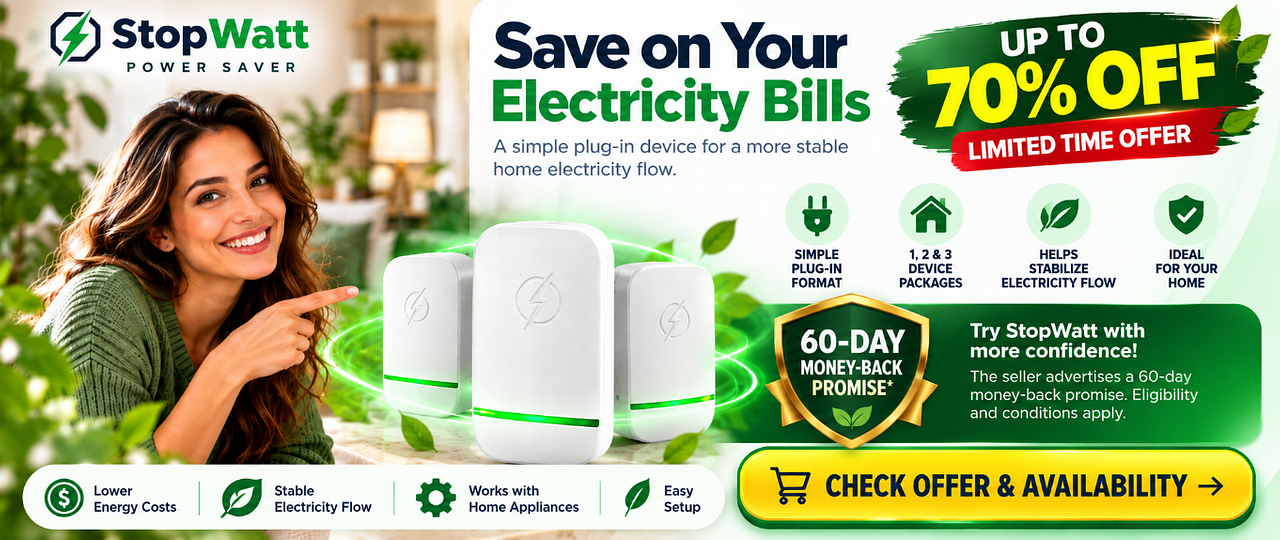
Rather than altering your utility meter or cutting back the power your appliances need to run, this plug-in energy saver acts as a localized buffer on your circuit. It is built for standard 90V–250V residential outlets and features a compact housing with a simple green LED indicator light that confirms active operation. For homeowners living in older properties with aging wiring or heavy inductive loads, devices like this are marketed as a straightforward, zero-maintenance addition to the home electrical setup.
[Explore StopWatt Power Saver specifications across the USA]
How It Works
To understand the StopWatt Power Saver, it helps to look at the difference between usable real power and wasted reactive power in an alternating current (AC) system. Inductive motors inside HVAC units, dryers, and older refrigerators often pull inconsistent bursts of current, generating harmonic distortion and minor voltage spikes along the line.
When plugged into an active outlet, the internal circuitry of this voltage stabilizer works through three primary mechanisms:
- Capacitive Smoothing: Built-in capacitors temporarily store small charges of electricity and release them smoothly when minor voltage dips occur, helping keep the sine wave steadier.
- Power Factor Correction: By balancing inductive loads with capacitive reactance, the unit aims to improve the local power factor, reducing the amount of reactive current bouncing back and forth through household wires.
- Harmonic Noise Filtering: Inductors and resistors help dampen high-frequency electrical noise (often called dirty electricity), allowing connected electronics to receive cleaner, more consistent power flow.
Because residential utility meters generally measure real power (kilowatt-hours) rather than reactive power, the practical benefit is less about dramatic overnight bill drops and more about reducing line heat, smoothing current spikes, and easing stress on sensitive motors.
Components and Build Materials
Since this is an electronic hardware device rather than a consumable supplement, its "ingredients" consist of its internal circuit components and protective housing:
- Flame-Retardant ABS/PC Shell: A durable, heat-resistant outer casing designed to stay cool during continuous 24/7 operation.
- High-Performance Capacitors: Core electrical storage elements responsible for smoothing minor voltage fluctuations.
- Inductors and Resistors: Filtering components that absorb transient spikes and reduce high-frequency line interference.
- Surge Suppression Circuitry: Internal safeguards built to clamp down on sudden voltage surges before they reach nearby electronics.
- Green LED Status Indicator: A low-power light on the front panel that confirms the unit is receiving current and functioning properly.
Key Benefits
For households looking to improve overall home energy efficiency and protect everyday electronics, the device offers several practical advantages:
- Appliance Longevity: By acting as a localized surge protector and smoothing out voltage irregularities, it helps shield refrigerators, TVs, and computers from premature wear caused by unstable power.
- Effortless Plug-and-Play Setup: There are no apps to pair, batteries to replace, or wires to splice—you simply insert the prongs into a standard wall socket.
- Cooler, Cleaner Electrical Lines: Reducing excess reactive current and dirty electricity can help minimize minor heat buildup in older residential circuits.
- Wide Compatibility: Works alongside standard household equipment, home office setups, and garage appliances without interfering with normal device operation.
Practical Use and Tips
Getting the best performance out of the StopWatt Electricity Saver Device comes down to smart placement and realistic expectations. For smaller apartments or single-story spaces, plugging one unit into a dedicated wall outlet located as close as possible to your main circuit breaker box allows it to condition the primary incoming lines effectively.
If you live in a larger home—typically over 1,000 to 1,500 square feet—or have multiple floors, placing one unit near the breaker panel and another near high-draw appliances like a laundry room or HVAC closet helps distribute coverage across separate circuits. Always plug the unit directly into a wall receptacle rather than a crowded power strip, and give the system at least 6 to 8 weeks (one to two full billing cycles) to observe any subtle changes in your baseline kilowatt-hour usage.
[Check current StopWatt Power Saver options in the USA]
Pros and Cons
Pros:
- Simple plug-and-play installation with zero ongoing maintenance required
- Built with a fireproof shell and internal overload protection for continuous use
- Helps filter line noise and cushion minor power surges for sensitive electronics
- Compact footprint does not block adjacent outlets in most standard wall plates
Cons:
- Will not cut electricity bills by 50% overnight, especially in newer homes with modern wiring
- Residential meters bill for real power, meaning power factor correction yields modest utility savings at best
- Larger homes require multiple units to cover separate electrical phases and circuits
Frequently Asked Questions (FAQ)
Is the StopWatt Power Saver safe to leave plugged in all the time? Yes, the unit is engineered for continuous operation and features a flame-retardant casing along with internal thermal and overload protection. Once the green LED turns on, it operates silently in the background without generating noticeable heat.
How quickly will I notice a difference on my electric bill? Because utility usage fluctuates with seasonal weather and daily habits, most households need 6 to 8 weeks to compare billing cycles fairly. Savings are typically gradual and modest rather than immediate or drastic.
Does this device illegally tamper with my electric meter? No. It does not bypass, slow down, or alter your utility meter in any way. It simply conditions the electrical current inside your home's internal wiring after power passes through the meter.
How many units do I need for an average house? A single unit is generally sufficient for a small apartment or condo. For medium to large houses with multiple bedrooms or heavy appliances, placing two to three units on separate circuits provides more balanced coverage.
Will it work in homes that already have modern electrical panels? It will still provide minor voltage stabilization and surge filtering, though homes with brand-new wiring and Energy Star appliances will naturally see smaller efficiency gains than older houses with fluctuating power.
Real User Reviews
David M.: "I bought a two-pack for my 1970s ranch house where the lights used to dim slightly whenever the AC kicked on. After plugging one near the breaker panel and one in the laundry room, the flickering stopped and my bill dropped by about eight percent over two months."
Karen R.: "Setup took literally five seconds. I didn't expect miracles on my electric bill, and the savings have been modest—maybe ten or twelve dollars a month—but I appreciate having extra surge protection for my home office gear."
Gregory T.: "We run a deep freezer and an older refrigerator in the garage, so I put a StopWatt Power Saver on that circuit. The units run quietly, stay cool to the touch, and seem to keep the power steady during summer heatwaves."
Melissa H.: "In a newer apartment, I didn't see a massive drop in kilowatt hours, maybe four or five percent. Still, it feels sturdy, doesn't take up much outlet space, and gives peace of mind against random power spikes."
Where to Buy
To ensure you receive a genuine unit with proper safety certifications and surge protection circuitry, it is best to order directly through the official StopWatt USA website or verified major retail listings. Buying directly from the official source typically provides access to multi-pack bundles—useful if you need to cover multiple circuits—along with a standard satisfaction guarantee and customer support if a unit ever needs replacement.
[Visit the official StopWatt USA site for details]
Conclusion
The StopWatt Power Saver is best viewed as a practical power conditioning and appliance-protection accessory rather than a magic fix for high utility rates. While exaggerated claims of cutting power bills in half do not hold up in modern residential settings, its ability to smooth minor voltage fluctuations, filter dirty electricity, and add a layer of surge defense makes it a sensible addition—particularly for older homes with heavy appliances. If you approach it with realistic expectations and pair it with smart energy habits, it offers a hassle-free way to support a steadier household electrical system.